



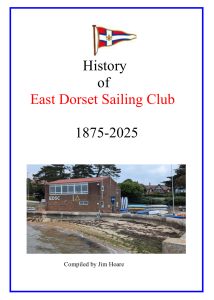
“History of East Dorset Sailing Club 1875 – 2025” written by Jim HoareThis great history was recorded by long time member Jim Hoare. In 2025 the Club celebrated 150 years since sailing started here.
Our membership is now around 200, to think in 1954 we had about 36 members, so times have changed. However EDSC remains a unique little sailing club on the edge of the second largest natural harbour in the world.
History of East Dorset Sailing Club
Based on History of East Dorset Sailing Club 1875–2025, compiled by Jim Hoare. Text and photographs from the supplied edition.
EDSC Today · 2005–2025
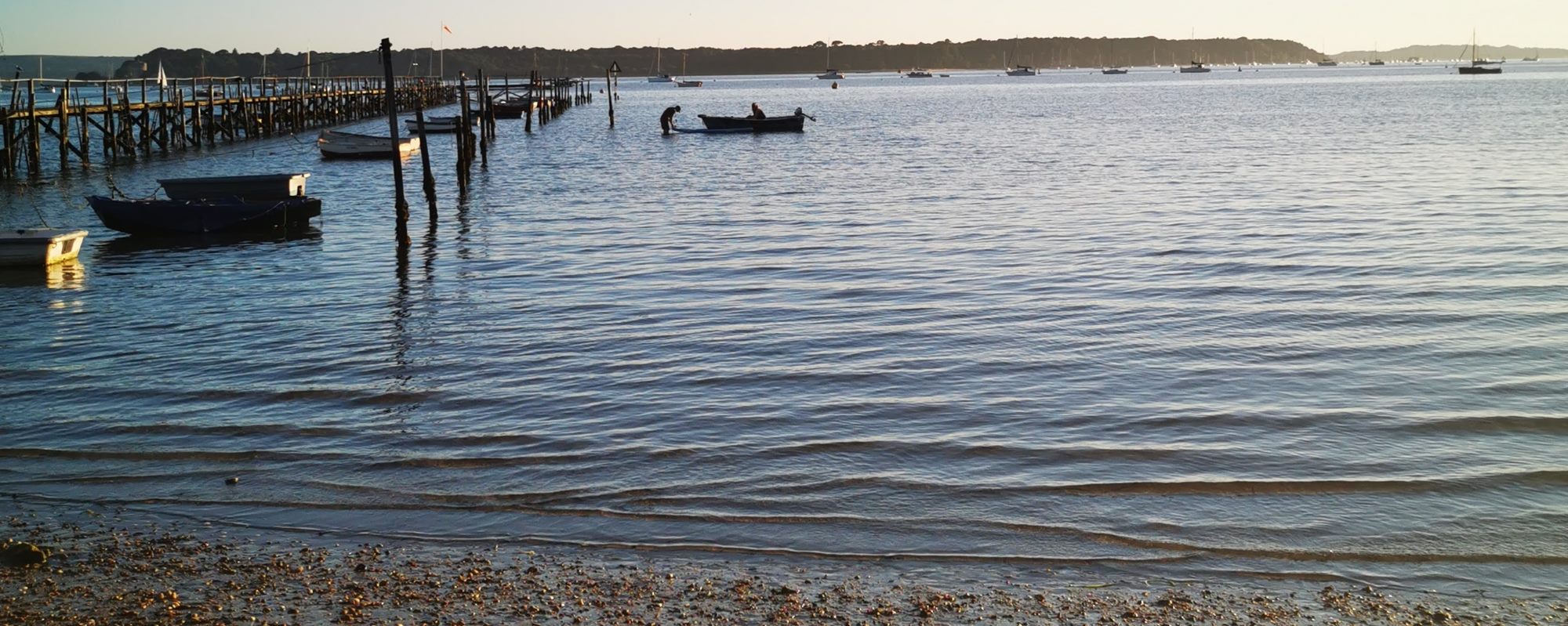
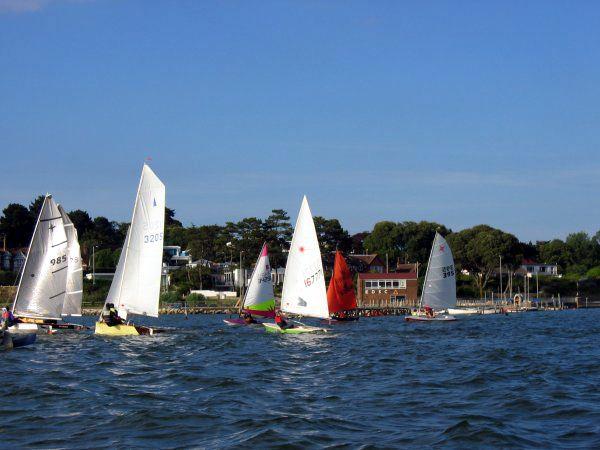
EDSC Today EDSC has changed a great deal over the last fifteen years since the first edition of this history was published. The number of dinghies and dinghy members has greatly increased at the expense of the cruiser membership. The Clubhouse has been up dated and modern technology has been introduced into all aspects of the Club procedures. The management of the Club has also become far more complex with new Health & Safety and food hygiene regulations having to be complied with. The Clubhouse has been completely refurbished. The ground floor now houses modern changing rooms with showers and toilets for both men and women. Up stairs the lounge area has been refurnished with modern soft furnishing and new tables and chairs. The kitchenette /bar area, that was originally built by Ray Styche has been modernised and now fully conforms with all hygiene and food regulations. The Rickety Pier Bar is still there! The in harbour races are now controlled from the first floor. No ten minute, five minute and start by cannon fire. This has been replaced by a traffic light system and horn. Safety boats are deployed and crewed by RYA certificated helms persons and these boats are in radio contact with the race officer and all boats racing. Gone are the days when elapsed times were recorded and then the officer of the day had to undertake complicated calculations to get the corrected time. It’s all computerised now. New H&S regulations have also required risk analysis to be undertaken on most routine operations and procedures formally agreed. The introduction of all of these new procedures makes the management of the Club a much more demanding exercise.
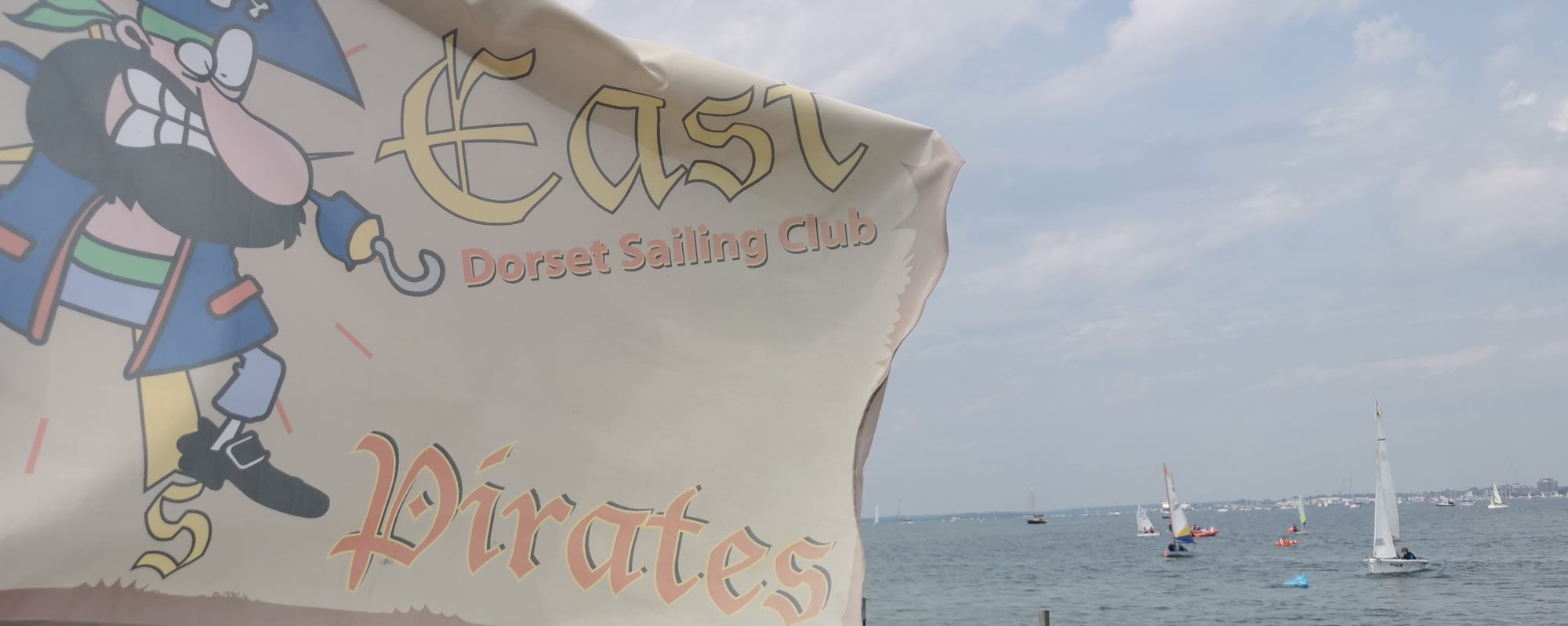
However the ethos of EDSC remains relatively unchanged. It’s still a family oriented Club and relies on DIY from members. Maintenance of the wooden pier has always been a time consuming and costly exercise. Dominic Coleman has been the driving force in maintaining the pier. Dominic and his team of helpers have done a marvellous job and the pier is probably stronger today than it’s ever been. As I know working on the pier in February and March can be very challenging and we all owe Dominic a great debt of gratitude. Dinghy sailing has really taken off in recent years. The Club now owns eight dinghies, two family-sized Topper Argos, two Fusions, and two Toppers, a Laser and an Optimist, which are all available for members to use on a fee-paying basis during the sailing season. This means that members don’t have to have their own boat in order to enjoy sailing from the Club. The purchase of these Club boats has proved very popular and attracted several new members. In harbour handicap dinghy racing has become very well supported with Lilliput SC members also participating. The cruiser section of the Club has taken a down turn in recent years. Out of harbour racing has all but ceased. Some in harbour handicap racing does still takes place, again with Lilliput SC also participating. Members these days are not so keen on getting into a tender and rowing or motoring out to their boats. They prefer to keep their cruisers in marinas or to be taken to and from their moorings by Club launch. The other section of the Club that is as popular as ever is Pirates. As mention previously this was the brainchild of Alison Wheeler, she has taught hundreds of youngsters the rudiments of sailing and was presented with a RYA Community Award by HRH Princess Anne in 2017 for her impressive contribution to sailing at grass roots level. Although Alison has now taken a back seat in running Pirates it is still extremely popular and it’s led by Kate Robson, Annabel Hodder and Becky Walters.

Typical Pirates Day at EDSC The summer car park has continued to be a problem in the administration of the Club. Maintaining its availability for members is essential. As mention previously a 25 year lease was put in place with Poole Borough Council in 1999 which expired in 2024. Obtaining another long term agreement has proved very time consuming, but recently Bournemouth Christchurch & Poole Council (BCP) has agreed to issue a 21 year lease and the period of use will be extended to run from 1st April until 31st October (instead of 1st May until 30th September). The saga regarding ownership and use of this strip of land has probably involved more time over the years than any other single Club management matter. Hopefully, the new agreement
with BCP will secure the use of the land for many more years to come. The overall management of EDSC has also changed. It is now registered as a Community Amateur Sports Club (CASC). The introduction of a corporate trustee, as an alternative to appointing individual trustees has also taken place. A registered company called East Dorset Sailing Club Limited has been set up and the three directors of the company are the Commodore, Vice and Rear Commodores. The Club’s deeds and titles are held in trust, with the Club being the beneficial owner. At the time of joining or renewing their membership of the Club, all full, joint and life members become members of ‘East Dorset Sailing Club Limited’. Members are limited in liability by guarantee to the sum of one pound. This action has removed all personal liability from the trustees. Although EDSC is one of the smallest Clubs in the harbour, it’s one of the most active and a larger proportion of the 230 members actually take part in activities than larger Clubs that have hundreds/thousands of members. A good example of this is the annual Bart’s Bash. Bart’s Bash is the flagship fundraising and participation event for the Andrew Simpson Foundation (ASF). Andrew ‘Bart’ Simpson was an Olympic Gold and Silver medallist who tragically passed away in 2013. Andrew passionately believed that everyone should have the opportunity to experience sailing and water sports, regardless of their background or circumstances. The first Bart’s Bash took place in 2014. Thousands of people from around the world came together to race in memory of Bart. The event was such a success it was awarded a Guinness World Record for the world’s largest sailing race. In recent years EDSC has raised more money for ASF than any other sailing Club in Poole harbour.
Celebration of 150 year anniversary This second edition of EDSC history has been written to celebrate the Club’s 150th anniversary. On the 13th May 2025 Her Royal Highness Princess Anne visited the Club together with other civic dignitaries and senior RYA officers. This was a marvellous occasion. It was a glorious sunny day with a light breeze and EDSC was decked out with bunting and about 60 members were in attendance. The Commodore and President greeted HRH Princess Anne and the Commodore, Ian Clayton, gave a short talk about the EDSC followed by a short talk about the history of the Club given by Jim Hoare. HRH then signed the visitor’s book and accepted a copy of the Club’s history. HRH was introduced to the VIPs in the lounge area, these included past commodores, other club officials and life members. HRH showed great interest in what was being said. She then went out into the yard and met a number of young sailors who had just come ashore. The President, Lindsay Court presented HRH with a Club burgee and awarded her honorary membership of the Club. HRH was invited to unveil a commemorative plaque and was presented with a bouquet by Tabitha Wheeler, the grand-daughter of Alison Wheeler. She thanked the Commodore and President and said it was fitting that EDSC’s 150th anniversary coincided with the RYA’s 150th. After HRH left a magnificent cake was cut by Mrs Court & Mrs Clayton, the wives of the President and Commodore and all present enjoyed a slice and further refreshments, thanks to Sue Tookey, EDSC Social Secretary, and her band of helpers.
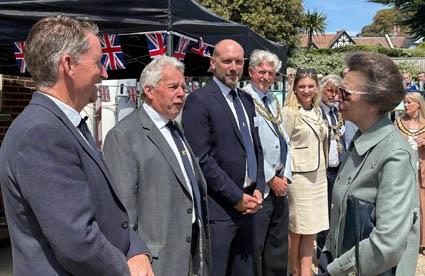
HRH Princess Anne meeting Lindsay Court EDSC President & Ian Clayton EDSC Commodore and other VIPs
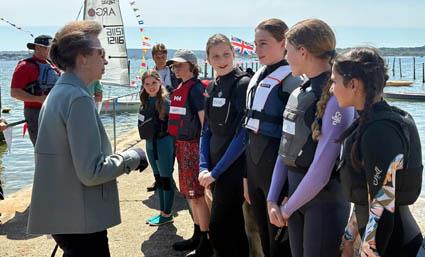
HRH Princess Anne meeting young EDSC sailors The East Dorset Sailing Club continues to thrive and is still that friendly family oriented Club despite all the modern technology and legislation that has come to pass. All the
Club activities can be viewed on the Club web site https://eastdorsetsailingclub.co.uk and a webcam that covers the foreshore, pier and mooring areas. Harry Noakes, wrote the following, ‘Born in the 19th century and now thriving in the 21st century the Club is still in many respects the same as it always has been. Members from 135 years ago would find that same enthusiasm for sailing. EDSC does not have elaborate premises, a bar or large catering facilities, but these are not what makes a Club. A Club is its people and as long as we have people who sail together, party together, and work together to maintain and enhance the facilities, then we shall thrive’. This statement still holds true in 2025 and hopefully will still apply when the Club celebrates it’s 200th birthday. Appendix 1
The Second Hundred Years · 1975–2005
Cocktail functions and dinners were held at Branksome Towers Hotel, Branksome Court Hotel, Harbour Heights Hotel and Sandbanks Hotel to name but a few.
The days when the Club charged the members 12/6 (62.5p) for a really good dinner at a luxury hotel and out of that were able to pay for the guests have alas, long since past.
Post 1969, with very few exceptions, EDSC used the new Clubhouse for all the necessary meetings and functions.
This first hundred years is well summed up by a quote by Leslie Lees, ‘One thing only can we be sure of. The wind will always be free! We are a sailing Club and, as long as we can get a boat afloat, put some sails on it, we are assured of being able to continue, as our founders did before the advent of the internal (infernal?) combustion engine to mess about in boats’.
The Start of the Second Hundred Years
In his foreword to the first Club history (1875-1975), Guy Emerson anticipated that the work of future historians should be ‘child’s play’ compared with the research required for the first edition. This might be so if all that was required was a chronological diary of events. The names of the officers, committees, subscriptions and ordinary business that is on record and readily available. However, in the second history written by Harry Noakes, he tried to record the life and spirit of the Club, particularly since 1975 when the first historical edition, written by Harold Geach and Leslie Lees finished.
Reading the AGM minutes for February 1974, there were three sailing events – the Candelabra Race, a Cruiser Race and the Regatette. The only social function mentioned was the members’ sherry party. The Regatette was a family fun
day, with games and competitions around the slipway and pier, all involved getting wet and messy. Blindfold dinghy rowing races, competitive crab fishing, eating doughnuts on strings, treasure hunts and all the usual shore-side antics combined to create a memorable day. It survived for many years but was gradually superseded by a similar event at Studland, catering for a growing number who loved to party but also wanted to do some sailing as well. Some of the youngsters who enjoyed those days are now full boat owning members of the Club.
The members’ sherry party was usually held in the autumn, at a cost of 50p each, the bar was in the little alcove under the stairs. Each Club in Poole Harbour also hosted, and still does, an annual Flag Officers’ Reception, to which all the local Commodores, the Mayor and local dignitaries are invited. At East Dorset all these people were gathered in the downstairs room. It gave a new meaning to the term ‘close company’. In the late seventies Club activity was growing quickly, putting pressure on the one room, that had seemed so commodious after the restrictive and cold original hut. Winter committee meetings were conducted in warm clothing with newspapers placed on the plastic chairs to stop the nether regions from freezing. In severe weather waves crashed against the window and water spurted in. Things were improved when Commodore David Moore (1977-80) arranged the installation of a modern double- glazed window.
Fireworks at the Club! In 1976 Ivor Healey and Harry Noakes had the idea of bringing their family fireworks to the Club. The idea grew and the event got bigger in later years, with a bonfire on the beach and sparklers for the children. Food was laid on, including soup, brewed in a ‘Burco’ boiler, and hot potatoes with various fillings. The weather was not always kind and sometimes a tarpaulin was lashed to the wall of the Club to create a lean-to to provide shelter for the catering. As far as can be remembered it was never cancelled, even though sometimes the wind was so strong it blew out the gas blow lamp used to light the fireworks. For some years there were well over 100 people present. On one occasion the bonfire was a bit big and the Fire Brigade turned up. Instead of putting the fire out they joined in and tucked in to hot dogs. Eventually the fireworks became prohibitively expensive and this combined with concerns about health and safety caused the decline of the event, which ended in the 90’s, although a party with sparklers for the children survived for a little while longer. The Continuing Saga of the Pier and Slipway Repairs to the pier are a constant theme in the records. The addition of a ‘hammerhead’, built by Dixie Deans, increased its usefulness allowing yachts to moor along side to replenish their stocks. It is worth recalling that the pier was originally built to reach a channel known as Whitley Lake and it was known as the Whitley pier. Whitley Lake ran from near Bullpit following the shore and petered out near the Blue Lagoon. At low water there was 3 to 4ft of water in it. Even in the early eighties several of the withies marking the channel were still there and often there was enough water to get away in a dinghy while the rest of the area was drying out. It was also very soft mud, not hard sand as it is now. The hydrology of this part of Poole harbour has changed significantly, probably due to the dredging of the main channels. There had always been concern about what it would cost to repair the pier if it should suffer severe damage. It had been hit and repaired several times, with most of the costs being recovered from the offending boat owners. It was feared that the premiums for such an old structure would be prohibitive. In 1978, Commodore David Moore, after much research, found an insurer and cover was taken for £2,000. This was fortunate for in 1987 came the hurricane; six EDSC boats came adrift, four being written off, and the pier was badly damaged. Perhaps not so obvious as the pier, the slipway is also a vital facility. Schemes put forward to date for improving it have all been impracticable or too expensive. Hence, it still silts up to the point were launching small craft can become a problem. For many years it was cleared with shovels, a backbreaking task, until William Bird brought in his mechanical digger, which did an amazing job in a much shorter time. William joined the committee and became commodore in 2011-14. Friday Night Sailing Series The Friday evening series of races started in 1980. Ron Cowdell ran a series of talks and demonstrations for those new to racing and unused to close quarter manoeuvring. These talks explained the basics and got across the message that the racing rules have to be observed! For those used to gentle sailing it was a steep learning curve and it is a credit to the organisers that the series grew and flourished. Racing was controlled from the roof of the Clubhouse and many visual and sound signals were tried. Eventually a modified 12 bore gun was bought, but sometimes with an onshore wind even that was not heard. Finishes were sometimes very late and on one occasion the race officer was in a dinghy moored to the buoy at the finish line calling out in the gloom ‘what boat are you?’ A measure of the increase of sailing activity is shown by the list of events for 1980. They included the Friday night series, Round the Island Race, IOW cruise, Lymington Rally, Candelabra Race, Beaulieu Rally, Cruiser Bay Race, Regatette, Swanage Bay Race and Christchurch Weekend Rally. The Commodore at that time was Ken Okey. After many years as a member he was elected to the committee in 1971 and at various times held every office in the Club. He was Commodore from 1980 – 83 and then President. Ken is the epitome of the long-serving Club member who worked hard for the Club both in and out of office, and we must not forget Beryl, his wife who acted as Club secretary from 1975 – 84. Tony Wood became Commodore in 1986-89 and was a particular driving force on the racing scene. He did a great deal of work on handicaps, organised courses and course sheets and generally chivvied everyone along. Handicapping for non rated yachts has always been a challenging task. Many Clubs used the RYA Portsmouth Yardstick (PYS) for handicapping yachts and dinghies, but with the passage of time more and more boats came onto the scene that did not have an ‘official’ PYS rating. Club handicappers had to determine a rating on ‘an ad hoc basis’ and also apply the infamous ‘handicapper’s allowance’, which was not a common standard and therefore caused many interesting discussions! It also meant that inter Club racing was difficult. EDSC used the PYS for many years, but in the 1980’s Ken Okey used a measurement system, calculated by hand, that was based on equations from Poole Yacht Club. In the early 1990’s Lilliput Sailing Club (LSC) took over the EDSC handicapping as they had a computer spreadsheet to undertake the complex calculations. In January 1995 a meeting was organised by LSC at which representatives from all of the Clubs in Poole Harbour and Christchurch Sailing Club attended. It was agreed that a common system for calculating handicaps should be used by all the Clubs and that a committee should be formed from representatives of the Clubs and a standard computer program should be developed to run on Microsoft Excel. This was the start of the Poole Harbour Handicapping System (PHHS). In 1997 Poole Yacht Racing Association (PYRA) also decided to adopt this system. Tony Tatham was appointed EDSC Handicapper in the early 1990’s and was actively involve in the introduction of the PHHS. Tony was Commodore from 1993-96. In 1987 Philip Okey was on the committee and took up the task of increasing dinghy racing and small boat events. The first dinghy rally was held that year and a dinghy class was added to the Friday series in 1988. Phil continued his efforts to increase the competitive sailing in the Club during his time as Commodore (1999-2002) and now a ‘fleet’ of multi class dinghies turn out regularly on Friday evenings. Phil is the son of Ken Okey and they are the only father and son to become commodores of EDSC.
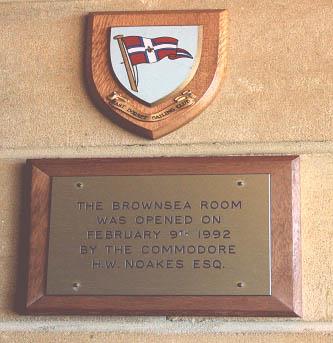
Cross Channel Cruises The first record of an organized cross-channel trip to Cherbourg appears in 1986, when four boats took part. The Club had finally left the image of the ‘potterers’ far behind. From then on foreign cruises in company became popular. On one occasion there were twelve boats at St. Malo. In addition to the cross channel ventures in the mid 80’s, there were two ‘one-off’ events worth recording. In 1985 there was a waterborne treasure hunt, which involved sailing around Brownsea Island collecting navigation and observation clues on the way, with extra points for picking up under sail a drifting box with further clues. In 1989 there was the Studland Sprint. A fair number of boats were anchored off the beach at Studland and, at a signal, crews rowed ashore in their tenders and then raced up the hill to the Bankes Arms where Mrs. Grange Bennett, widow of a former Commodore, presented a tankard to the first to arrive and handed over a Club burgee. Mrs. Grange Bennett also provided a supply of beer and ploughman’s lunch to all taking part. Expansion of Club Facilities In the early eighties pressure on space in the Clubhouse increased as social activity grew. In 1983 it was agreed that the Club simply had to provide more space for the annual Flag Officers’ Reception. A marquee was hired and rigged to extend from the wall of the Clubhouse out into the car-park. The main reception was in this marquee, with the Clubroom as an overflow. Decorated with flags and flower arrangements, it looked very good indeed. In some places one can still see where the fittings were screwed to the wall and the anchor points in the car park. In order that the whole Club could benefit from the exercise the marquee was kept for two days and a members’ cheese and wine party was held – starting a fixture that continued for many years. Sometimes it was given a theme and on one notable occasion members came dressed up as pirates! There is a note that in 1989, 85 members drank twenty one 1.5 litre bottles of wine and six litres of orange juice. ‘Summer’ Car Park The land where the summer car park is situated used to be a rough beach, mainly used by fishermen, and sometimes tenders were left there. In the mid 1970’s the Council placed rock and wire gabions on the seaward side and in filled the area and it became a useful piece of land. Car parking at the Club had always been a problem and the idea of using this new area was very attractive. During the early 1980’s there was a lot of correspondence regarding ownership of this area of land. If it could be shown that it was part of Lord Wimborne’s Estate, then the Club could conceivably have a right to it. However, no owner could be found and EDSC could not demonstrate sole usage, so the Club could not claim ownership of this piece of land. Lengthy searches & negotiations were undertaken and in the end it was assumed that the land was owned by Poole Borough. A lot of work was undertaken liaising with the Council to get the best terms and conditions and this enabled the Club to secured the first three year licence in 1986 to use this area as a fenced off car park during the period 1st May – 30th September. This addition area provided much needed car parking space, thereby freeing up the Club forecourt for the increasing number of sailing dinghies. A car park levy was introduced to meet the annual fee paid to the Poole Borough Council (PBC). The County Council also agreed that the Club could have the strip of land between the front fence and the pavement on Sandbanks Road. This allowed the fence to be moved, and although still narrow, it provided access to the summer car park, and some extra dinghy space. Wind surfing activities boomed during the early 1990’s, and various proposals were put forward to cater for the shore needs of the surfers. There was a fright for the Club when the Poole Local Plan, published in 1995, proposed that ‘land to the west of the EDSC (where we now have our car park) is suitable for the provision of changing rooms, toilets, showers and an information point for the wind surfers’. The Club lobbied hard to raise objections both from within the Club and local residents, and the proposal was dropped and the facilities were provided elsewhere. The Club entered into several short term agreements with PBC and in 1999 the Club secured a twenty five year lease with PBC. Club Improvements and Extension On the wall in the kitchenette of the Brownsea room is a plaque recording the Howard Bequest. Ray Howard, who died in 1989, served on the committee as Treasurer and Rear Commodore. The bequest was used to refurbish the rather primitive kitchen in the downstairs room. The plaque records his family’s act of generosity. Other donations of note include the large Club flag given by Derek Burrell Davis, the flagpole by Dot Koster in memory of her husband Ray, a past vice-commodore and a fine set of weather instruments from Ken Sims.
The most significant event of the late 1980’s was of course the development of the Clubhouse. In the minutes of 1983 is the first mention of extending the building, but it was 1988 before there was any action. The roof at that time had some teak seats for those wishing to bask in the sun, but it was also a repository for rubber dinghies, sail boards, dinghy masts and other sailing gear and general junk. The idea was an ongoing topic with opinions varying from outright ‘no’ to ‘why are we waiting?’ It was also evident that if the extension was not done then considerable work was required to maintain the integrity of the existing building. No real progress could be made without planning approval. Detailed plans were drawn up by Don Hills, the architect for the original building, and the application was lodged in October 1988. This short statement belies the great amount of work required to get to this stage. There is a very thick file on the project and Jim Hoare, who acted as agent for the Club, worked tirelessly, battling with the bureaucratic nightmare of the planning regulations. Once the application was made public there was the expected uproar from the antis and the ‘Nimbys’. The Council moved slowly and, in spite of Jim’s prodding, no decision had been given by the time of the AGM of February 1989. However, there was optimism as to the outcome and at the AGM a presentation was put to the members. We can do no better than to quote a precis of the presentation as set down in the minutes of that AGM. The Commodore reported that the Finance & General Purpose Sub-Committee had looked at various proposals for Club development and had decided that the extension and improvement of the Clubhouse was the one that would benefit most members. He then asked the Vice-Commodore, H.C (Jim) Hoare to present the case. The Vice-Commodore drew the attention of the meeting to the plans and photographs that were displayed in the hall and took the opportunity to thank Don Hills for all his help in drawing up the plans. With the aid of transparencies and the overhead projector he explained to the meeting that the proposals consisted of providing a large lounge area on the 1st floor of the Clubhouse and modifying the ground floor to include a shower and cloakroom facilities. The extension would involve raising the present external wall with matching brickwork, a large picture window to seaward and a two-pitch roof similar to that recently used at Redcliffe Sailing Club. Planning would be considered on February 23rd. If approved we would have to meet the Building Regulations, engage a builder and make a start in the autumn. The roof should then be on by Christmas and it would be hoped that the lounge would be ready for the next AGM. He then listed a number of benefits to members, including a comfortable lounge area for meetings and social gatherings, a wet area downstairs for dinghy sailors and a catering area separate from the lounge. He also felt that the improved facilities would attract new members and be a good investment. With the help of Ken Okey he had been to three builders for estimates and Peter Chapman had obtained a quotation for windows. He felt that it would be necessary to engage a professional builder for the brickwork, roof and windows and that the wiring and plumbing downstairs could be done on a DIY basis. It was possible that we may have to provide a fire escape which would have to be an integral part of the building. If this was the case, then the estimated cost would be in the region of £28,000. He then discussed ways of raising the money and suggested that the meeting should consider the proposals today, take a vote to see how the members felt and, if in favour, the committee should proceed with a questionnaire to all members.
The Commodore then thanked the Vice-Commodore for his presentation and invited comments and questions from the meeting. The main objections were:-
• The Club is satisfactory as it is
• We do not require these changes
• We will lose the benefit of the roof space
• Too many social events will change the attitude of the Club
• The changes will attract rich members who will join just for the social events.
The Commodore stated that there was no intention to increase the membership above 100 and that the proposal would not attract social members. Some members were concerned that the present members were being asked to pay for these improvements and new members would get the benefits for nothing. The Commodore explained that we were all benefiting from the earlier members who paid for the present Clubhouse. He also stated that it was proposed to increase the joining fees very substantially. After further discussion it was proposed by Arthur Parrott that, subject to receiving the necessary planning permission, the members approve the project in principle and the Committee proceed with their detailed analysis. This was seconded by Ron Warburton and carried by 33 votes to 11. In March 1989 came the news of planning refusal. Jim Hoare got to work again, researching and polishing arguments for our appeal case. If anything, this was more difficult than the original application and very time- consuming. It was all made worthwhile when in December 1989 our appeal was allowed and permission granted. It was now necessary for the members to decide whether to go ahead with the project.
It was not until May 1991 that an EGM was held to decide the matter of the Clubhouse extension. To ensure that the proposal was not voted through by a minority of members, the first motion was that for the proposal to succeed 75% of votes cast should be in favour, and this was agreed. On the second motion, to proceed with the project, the vote was 57 for, 23 against, and the motion was lost. The shock of losing the motion, after all the effort, was hard to bear. Unless one studies the thick file of paperwork generated by the efforts of all concerned, one cannot appreciate how much work and time was involved in getting to this point. It was too much for the obvious majority present who wanted to go ahead and the required number of members signed a requisition for a further EGM. This second EGM was held, and the proposal succeeded by a 10-1 majority. At this time the building industry was in the doldrums and it was therefore a good time to get competitive tenders for work such as brick-laying, though it would be essential for as much as possible to be done by members. There was also the matter of raising the funds. Fortunately our treasurer, Alistair Matthews, a professional accountant, was on hand to make sense of the finances and to produce excellent accounts during this critical period. Eventually a scheme was agreed where each member contributed £250, either as one payment , or it could be by instalments for up to five years. Contributions in excess of £250 were welcomed and several members did so. There were also cash donations including £1,000 from John Trapnell. Members were also asked to make loans to the Club to cover the shortfall caused by instalment payments. It was very heartening that the offer of loans was heavily over-subscribed.
A key factor in getting the finances agreed by the members was the detailed accuracy of building costs provided by Jim Johnson, a Club member and chartered surveyor. Jim tackled the bureaucracy of building regulations and acted as Clerk of Works and Site Manager during the construction. Before building upwards, it was first necessary to remove the coping stones from the parapet and to remove existing roof covering. This was largely done by volunteer members. The brickwork was contracted out and thereafter the building work was mostly done by various members. Throughout design, planning and execution it was to be the essence of the project that it should be of a high standard, energy efficient and low maintenance. Over thirty years later it is apparent that this was achieved. With the upstairs completed, refurbishment continued with the provision of the ladies facilities and the gents showers. Once again we were fortunate enough to have ‘in house’ expertise in the person of Derek Collins, whose building firm carried out the work, much to the Club’s advantage. Derek went on to be Commodore in 1996-1999 . The bulk of the redevelopment was carried out whilst Harry Noakes was commodore who put great energy into initiating the project and driving it forward. There is no written record of the many members who assisted the project by giving freely of their time and expertise, equipment etc; their assistance was recorded with gratitude. It is to the credit of all those involved that the project was completed on time, on budget and without recourse to outside financial assistance.
Votes for Ladies
In November 1990, the then Commodore, Harry Noakes, raised the question of votes for women. It was evident that the Club depended increasingly upon a fair number of ladies, wives of full members, who as pier members had no say in the running of the Club. They could of course become full members in their own right, but this would be expensive and could also put pressure on the allocation of facilities. He proposed that a new class of membership, at a modified subscription, should be created where both parties could have a vote, this would be known as joint membership. A meeting was held to put the idea forward to the membership and formally to amend the rules. Judging by the minutes of this meeting the proposal was adopted in very short order and tea and biscuits were then served.
The Social Scene With the Brownsea Room complete there was a marked increase in social activities, particularly during the winter. Many of the now regular events became established, pub games, quiz night (with piping hot fish and chips from the mobile chippie) cream teas arranged by Lynn Haskett, and other one-off gatherings such as an evening tying knots, history of Poole with slide show and pre-season get- togethers to plan summer cruises. Cruising in company became one of the strengths of the Club. Groups of Club boats have visited just about all of the ports and anchorages in the Solent and the West Country and a large number of those along the Normandy and North Brittany coasts. Many new-comers to cruising have cut their teeth by being a crew member in one of these groups. Having family boats together is a great advantage for the children. This was particularly evident in 1990 when John and Heather Knott and their five children joined and became very involved in family cruising. Whether at home or abroad ‘Mr Toad’ was seldom without an escort of other boats laden with children. John also organised a Boxing Day car treasure hunt; great fun which ended back at the Clubhouse with hot toddy and mince pies. This event ran for several years. The Friday evening races, as well as increasing sailing activity, provided occasions for social gatherings when all can join in after-race suppers and members can visit the Club and be sure of finding company. The catering for these suppers was done by a handful of volunteer members, and here we must mention Mavis Styche who was ever-present when needed. Mavis also organised many of the annual dinner – dances. Socialising and sailing came together at raft-ups, usually held in South Deep, they were very popular, but there have been some notable ones. In about 1990 there were upwards of 12 boats, all swinging to the anchor of the centre boat ‘Rosalind’. The weather was fine and there was a great deal of to-ing and fro-ing with food and drink. When the tide turned the whole raft swung as a block, much to the consternation of passing traffic, particularly the large tripper boats. All went home very happy and left ‘Rosalind’ to get her anchor up from deep in the mud. Occasionally a raft-up would be host to a swarm of dinghies, the cruisers playing mother ship to the crews. This event continued for many years. Junior Sailing Days & Pirates More dinghy members joined the Club and there were many more youngsters taking part in the Friday evening racing. Commodore Tina Neely (2005-08) with help from her husband Paul, and Alison and Simon Wheeler, organised the first Junior Sailing Day in 2005. Initially a few teenagers in toppers participated in the ‘training exercises’ and ‘fun races’. After a couple of years the adults realised it was great fun and wanted in, so it became a Junior/Senior Day. In these events the Junior helmed and the Senior was the crew. These events provided excellent training and racing for teenagers. But Alison Wheeler realised (after many years sailing with a small child in her Mirror dinghy) that ‘somebody’ should do something for the young children, so she started Pirates in 2007 for children under the age of 12. Pirates proved to be very popular with the youngsters. The purpose of Pirates is to create a child friendly setting where the children of EDSC members can have fun on the water and develop the skills of sailing. The children can earn badges that recognise their achievements. Moorings The average Club cruiser gradually got larger, better equipped and frequently of deeper draught than in earlier times. Negotiations with the harbour authorities secured a steady increase in the number of moorings available to the Club. Mooring maintenance has always been a bugbear. It is nothing short of incredible that people will go into hock to buy a boat and then skimp on the few pounds needed to keep it safe. The harbour mooring officers had been berating the Club for poor maintenance and haphazard distribution of the inshore moorings, and sailing secretaries had tried various schemes to encourage safe practice. Dave Wright, during his time as Commodore (2002-05), put a great deal of effort into upgrading the moorings and bringing all Club moorings under the control of the Club. The individual 24 deepwater moorings adjacent to the Main Channel (MC) were put onto two trots. The 18 moorings on the edge of the North Channel (NC) were also put on a trot and three inshore shallow water trots were also laid providing another 17 tidal moorings, giving a total of 59. This was subsequently increased to 65 with an additional six midway deepwater mooring being added to the harbour entrance end of the inshore MC deepwater trot.
Annual Dinners The first record of a Club ‘dinner’ in the ‘second hundred years’ appears in December 1982. Organized by Ray German, (Commodore 1983-86) who did much of the groundwork in the growing social life, it was attended by 42 members at the Sea Witch in Canford Cliffs. It was a friendly and lively affair, the highlight (or not, depending upon where one was sitting) was when a waiter dropped a huge platter of roast duck – hot and swimming in fat and gravy, onto the lap of a male guest! The first dinner – dance was at the Durley Hall Hotel in 1984, and a tradition was started when a few Lilliput Sailing Club members joined us for the occasion. Skittles evenings were arranged at various local pub venues and occasional suppers at local pubs. In 1983 a laying up supper was held by EDSC at Lilliput Sailing Club and this marked the beginning of close co-operation between the two Clubs. It is worth noting that Ray also became Commodore of Lilliput Sailing from 1990 to 1993. In 1986, the dinner-dance was moved to the Allendale Centre in Wimborne, which proved to be a popular venue and was retained for several years. The increase in sailing events had resulted in more cups and trophies to be awarded. Previously awards were presented in the open by the Clubhouse, but the new venue provided an opportunity for a more elaborate presentation, which took place after the meal and before the dancing. The dinner dance and presentation evening continued to be a popular annual event for many years, but members gradually lost interest in this type of formal occasion preferring less formal events which has happened in many other similar Clubs.
The First Hundred Years · 1875–1975
The First Hundred Years In the Beginning It all started in 1875 when a small group of local people used to keep their wooden sailing dinghies on the foreshore at the bottom of Evening Hill in Poole. They chose this area of Poole Harbour because, in those days, a channel, navigable by small boats led out into the main harbour. The EDSC ‘pioneers’ decided to build a small pier alongside this channel so that they could moor their sailing boats rather than heaving them out onto dry land. It is an odd coincidence that three of the existing Clubs in Poole Harbour all started in very much the same way. Parkstone Yacht Club, East Dorset Sailing Club and North Haven Yacht Club all evolved from small groups of yachtsmen who kept their boats at various mooring stations. Parkstone Yacht Club is a direct descendant of Parkstone Lake Pier Committee that was set up in July 1894 to provide a pier for boating from Weston’s Point and Parkstone yachtsmen began building their pier in 1894. Likewise East Dorset Sailing Club is a descendant of the Whitley Lake Pier Committee. North Haven Yacht Club evolved from the former North Haven Lake Boat Owners Association. The inshore land where EDSC built their pier was owned by Lord Wimborne and when he heard about the pier his agent wrote the following letter to Mr Beckford, the Commodore.
Dear Sir,
I observe, that a pier for boats has recently been built opposite Flag Farm Estate Parkstone, and upon making enquiry received your name and address as one of the parties who had been concerned in it.
As the Pier has been built upon Lord Wimborne’s land and without his sanction, I must ask you to remove it within one week from this date or pay an acknowledgement of £1 a year.
Yours faithfully,
C. Paterson
Mr. Beckford, it would appear, was a man not to be trifled with. He offers his Lordship half a crown (2 shillings and 6 pence in good old money) and it was accepted after some negotiation.
The earliest ‘Club’ records were produced once a year only and sometimes consisted of no more than six lines, including ‘those present’, so the early history of the Club has been deduced from cryptic references, old letters, and entries in the accounts. The first recorded minutes of the ‘Club’ are dated 18th December 1896, and refer to ‘The Proceedings of the Pier Committee’.
Those present were:- Mr. F. J. B. Beckford (Chairman), Mr. H. Forde, Colonel Everett, Mr. J. H. Slade, Mr. G. Peck, and Major Webb.
This was obviously not the first meeting, because Mr. Beckford resigned his position of Secretary, which he held in addition to being Chairman, and, after expressing their thanks to him, the members elected Major Webb to fill this post.
Unfortunately the first minute book has been lost but it is clear that Mr Beckford was very much the driving force in directing the activities of the fledgling Club. It appears that he made a request to the Trustees of the Quays of Poole to deepen the channel from the pier to Whitley Lake and received a reply telling him that it was not their custom to allow dredgers to be used for private purposes. He found it entirely unacceptable. ‘My proposal would be an improvement to the harbour and of benefit to the Borough’. Apparently he got his way because in 1895 comes a promise from the Borough Surveyor to draw up plans for a pier twenty feet longer than that originally envisaged, together with a new slipway.
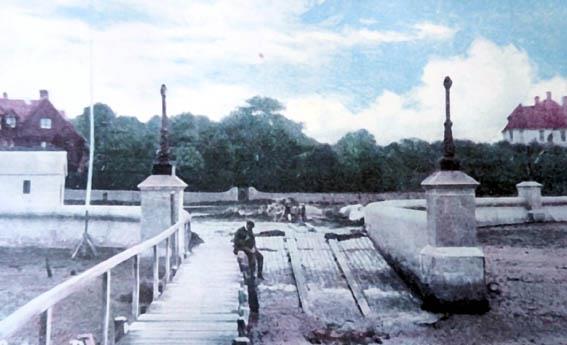
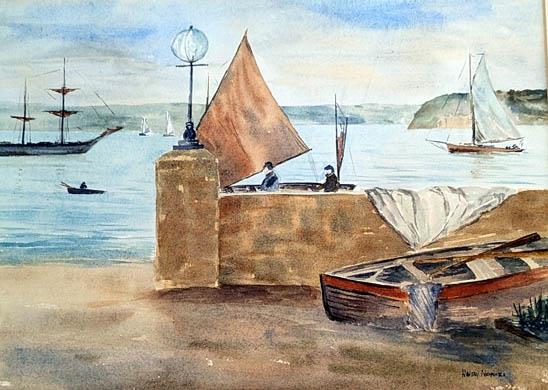
Slipway circa 1896 & artist impression by Harry Noakes
Matters did not go smoothly, however, in the matter of Lord Wimborne’s ‘half crown’. Someone had evidently told the pier committee that the particular piece of foreshore where the pier had been constructed did not belong to his Lordship, and the rent was withheld, much to the agent’s considerable wrath. “Pay up or we shall demolish the pier” he writes; and then, changing his attack a week later, “Pay up within a week or the rent will be made £5”.
The threat was not carried out, the pier remained and it appears that no payment was made to Lord Wimborne from 1896 until 1901. There is reference to an agreement having been signed in 1899, so one presumes that the half crown payment was reinstated. Presumably Mr Beckford and his colleagues brushed such matters aside and just got on with sailing.
In 1896 at a meeting it was resolved, to payoff a debt of two pounds eight shillings and seven pence (£2.43) by having a whip around of five shillings and six pence (28p) each from the nine remaining members. It was also agreed to establish an annual subscription of one guinea, payable in advance, as well as seeking a loan in the sum of £1 from each member. If sufficient money was raised it was proposed to extend the pier, which can have been little more than a landing stage, to the north side of Whitley Lake.
They met again in 1897. £66.5s.6d (£66.27) had been raised, more than initially expected. £41 was paid to Mr. Guy for the first extension of the Pier, a new hack boat purchased for £7, a pair of rowlocks for two shillings (10p), and two notice boards for eleven shillings (55p), which left them still in funds.
The 1898 meeting was a little longer, and they decided to employ a Pier Man at fifteen shillings (75p) a week, (a reasonable salary in those days!). The accounts show that he was provided with a jersey at eleven shillings and sixpence (58p), plus one shilling and eight pence (8p) for a Club inscription, together with a cap at half a crown (12.5p). The pier man’s duties included bailing out and keeping clean all boats belonging to members, transporting members to and from their boats, keeping the slipway and pier clear of weed, assisting in the launching, hauling out and scrubbing down of members boats. His hours were 0900-1800. At this meeting there was a balance of £3.1.4 (£3.07) in the credit account. Before going home, they resolved to ‘make representation to Bournemouth Steamboat Company as to the inconvenient and dangerous speed at which their steamers proceed up and down the harbour’. Nothing changes!
By 1897 the ‘members’ considered the Club had been established, and this is possibly why there is that mysterious difference in dates which appears in Lloyd’s Register of Yachts, one giving the year of foundation as 1897, and the other, which is probably correct, and has been generally accepted, as 1875. Mr. Beckford must have felt that 1897 was the year that really counted. Other members must have often heard him speak of the days, back in 1875 when they first planned to build a pier to which they could moor their boats. Colonel Sherston was Secretary at that time and he and his wife must have discussed the matter frequently and done a lot of research and when Mrs. Sherston became Commodore in 1933 – her husband had died in 1931 – one of the first things she did was to register the Club with Lloyd’s as ‘Founded in 1875’.
In 1895, Poole Corporation built the sea wall around the harbour side and when they reached the EDSC pier they built a stone slipway. This slipway was built with public funds and therefore one would assume intended for public use. Lord Wimborne was again not happy with this development because he considered the seawall and slipway had been built on his land without his consent. The Poole Corporation did not agree. The intrepid EDSC members were not interested in the ensuing disagreement between the Poole Corporation and Lord Wimborne, because they had their pier, seawall and a nice stone slipway that made it much easier to launch and retrieve their heavy wooden boats.
Having acquired these facilities the Club applied for permission from the Board of Trade to extend the pier into deeper tidal waters. This was granted and a wooden pier 283 feet in length was constructed to reach the north side of Whitley Lake. Also a small shelter was built for the pier man. This is the first reference to any building, but in 1902 it was resolved to appoint a committee for the design of a cycle-shed, 16ft. x 10ft., the estimate for its erection was £15. The results of their labour still exist in a rough sketch that bear some resemblance to the corrugated iron building which was subsequently erected and used as the Club house for many years, until it was replaced in 1969.
The Club gained Lord Wimborne’s and Poole Corporation’s consent to erect these buildings and to fence off that area of land. This letter is from the Town Clerk, dated April 1904, and refers to permission to build a fence.
‘The Council will give such permission,’ he writes ‘subject to the payment of one shilling per annum, and an undertaking being given to remove the fence at any time when called upon.’
The fence was built in 1904 but the following year they were told to remove it as complaints had been received from the general public because the slipway had been built with public funds and should be open to all residents not just for EDSC members.
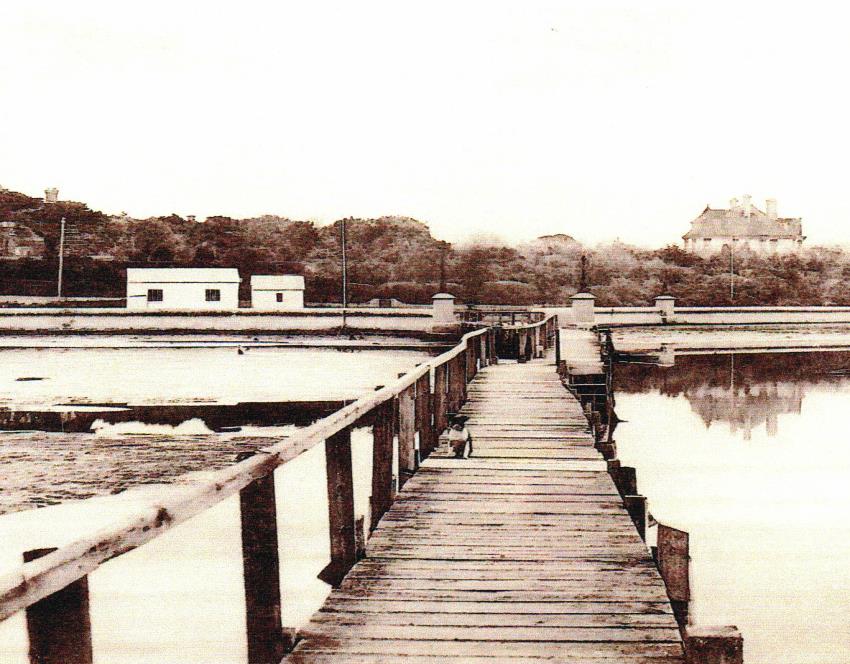
EDSC pier with bicycle and pier man’s sheds. Circa.1900
At the Annual General Meeting for 1904, which must have been extremely short, they merely passed a resolution naming themselves “The East Dorset Sailing Club”, and agreed to adopt a flag designed by Mr. Shaw Yates. The problem regarding the fence and general public access was not mentioned. However in 1912, a lengthy letter was written by a solicitor for the Club, and addressed to Lord
Wimborne. It refers to the considerable trouble there had been of late with people breaking down the gates to get to the slipway, and relates how the Club issued a summons against two men whom the magistrates, three being members of Poole Council, refused to convict. Now the Club wishes to know what steps Lord Wimborne would adopt to protect the rights, and give peaceful possession, to his tenants.
We never hear the outcome, except his Lordship’s solicitor asks about the nature of the principal offender. ‘Is this gentleman a man of means or a man of straw?’
However, whichever way it went, we know that pier, capstan, slipway and fence remained the property of that small, but determined band of men who were now established as the ‘East Dorset Sailing Club’ .
The number of members remained small and in 1914 there were nineteen members paying a full subscription of two guineas and seven shillings with pier members paying half of that sum. The First World War years then intervened and all the records ceased. Those members who were not directly involved in the conflict agreed to maintain the wooden pier that often got damaged in winter storms. They funded this work from their own resources.
Post First World War
Club records were resumed in 1919, and once again we find the name, F. J. B. Beckford, heading the list of those present. Surely, if anyone can claim to be the ‘founding father’ of the Club, it was this gentleman. He served the Club for forty seven years or more. His name still figures in the minutes for 1922, when there is a gap in the records of two years, and then his name is no longer seen. On occasions he served as secretary in addition to being chairman/commodore.
The Minutes resumed in 1925 and Mr. H. J. Sykes was Commodore, so we can only assume that our Founder had come to the end of his long term of office. Mr. Sykes also served for a long period and did not resign his office until 1932, being followed by Mr. Reginald Young who unfortunately died during his first year as Commodore.
The first Lady Commodore was elected in 1933. Mrs. E. Sherston accepted the office knowing that she had what appeared to be a sinking ship under her feet, and she took urgent measures to save it. The Club faced low membership and expenses that it could not meet. The Club had incurred an overdraft at the bank. Mrs. Sherston called a special meeting, and must have told members that they should make up their minds whether the Club was to continue in being. The minutes record that there was not only an unanimous decision that the Club should carry on, but also that all present would assist with a donation of three pounds and ten shillings (£3.50) each, sufficient to cover the deficit, and in 1934 the Club recorded a small credit.
Mrs. Sherston regrettably died in 1935, shortly after resigning as Commodore.
Obtaining the Freehold
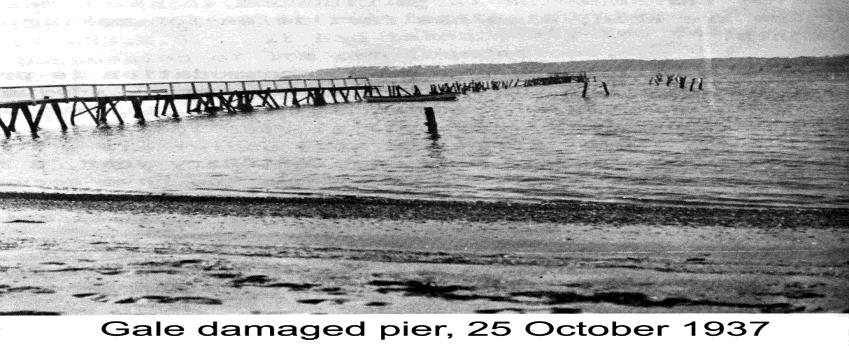
In 1935 Mr. Sykes once again became Commodore, and in 1937 an event of great importance in the Club’s history occurred. The Club was able to sign an agreement with Viscount Wimborne for the purchase of their site on payment of thirty three pounds four shillings and sixpence (£33.23) It had taken sixty-two years to achieve freehold possession of the site. The money was again raised by donation, and even after having to repair eighty-five yards of storm damage to the pier, the Club had a deficit of fifteen shillings (75p) only. All seemed to augur well for the future when war intervened again.
Post World War 2
The Club went into hibernation during the war years and the 283ft wooden pier had to be dismantled because Poole harbour was heavily involved in various military activities. In 1945 the Club burgee was once again hoisted and sailing recommenced.
The first task of the Commodore, Mr. Percy Woodcock, was to convene a special committee to assess the cost of replacement of the wooden pier, and put the necessary claim to the War Office. A sum of £1,274 7s 8d was agreed, and in 1947 the pier was rebuilt. Its opening marked the beginning of a period in which the Club no longer had urgently to seek new members, nor struggle for its rights of tenure.
By 1948 the membership had doubled to 50, and the Club’s title to property of the pier was entered at His Majesty’s Land Registry.
The pier man was reinstated and he was expected to attend the Club daily from 1st April till 31st October. His wage was £2 per week in season and £1 per week out of season. He supplemented this payment by undertaking work privately for members. The pier man’s duties were varied over the years and the post was abolished in February 1965 in order to cut the running costs of the Club.
The Club premises were repaired and improved. Partitioning was added to provide a Clubroom, gear storage area, toilet and hand basin. The old corrugated iron building had served the members well and with copious quantities of tar and patches, and coats of paint it lasted another twenty years until there came a time when the Commodore, Capt. George Stead, together with his committee decided that they had listened to it groaning in the winter gales for long enough.
The New Clubhouse
A brick built Clubhouse was decided upon, which would, although modern in design, blend in with the landscape. This was a single storey building with an open ‘top deck’ approached by an outside stairway, which was considered ideal for picnics, sunbathing and watching the ever- changing yachting scene. There was no bar but the ‘large’ Clubroom in which meetings and parties were held also had facilities for making refreshments.
Separate toilet and changing accommodation was provided for men and women. A ‘gear’ storage area, adequate for 80 sailing members, that incorporated a separate motor and petrol storage bay, was also provided.
The architect was an EDSC member, Mr. Don Hills, who, from his position within the Poole Corporation Planning Department, was able to deal with the passage of the plans through the necessary formalities with the minimum of
trouble. He was first asked in August 1968 to submit a plan and, by October, when he was co-opted on to the Committee, he was able to produce a plan ‘Approved in Principle’.
The plan was finalised and tenders went out, and builders H. R. Briggs of Bournemouth were given the contract. Demolition of the old building began on 1st March 1969, and the new building was finished on 31st May as promised.
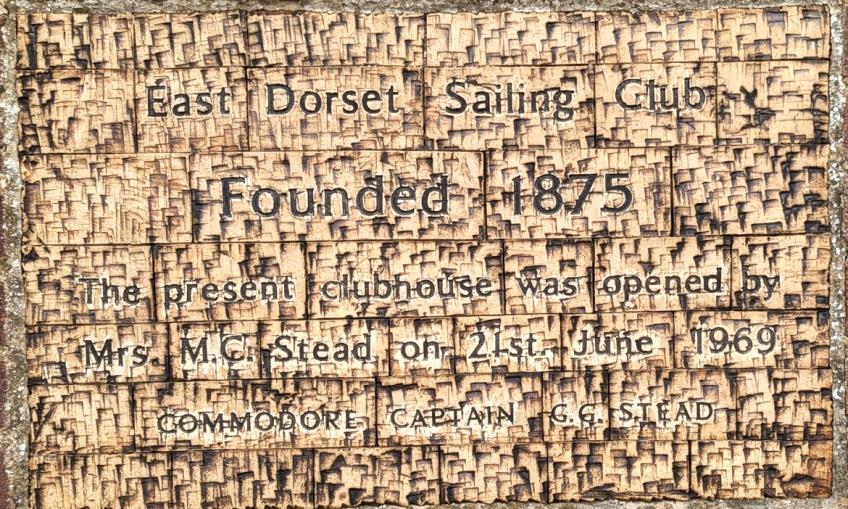
Commodore Capt. George Stead, who had already served the Club in this capacity since 1962, plunged into the mass of work necessary to get the project under way. The new Clubhouse was speedily completed and formally opened by Mrs. M. C. Stead at 19.00 hrs. on 21st June 1969, by unveiling a plaque set into the outside wall near the main door. This plaque was designed and executed in ceramic tiles by Mr. Bernard Charles.
As well as doing all the planning and organising ‘George’ frequently lent a hand with the work himself. In fact, he and
another member, Mr. Hedley Hill – who was an electrical contractor – did the whole of the electrical installation at no labour cost to the Club.
The building of the new Clubhouse was financed from members’ own resources. As the records show, no outside financial help has ever been sought, a long standing tradition of EDSC members, which, in view of the small membership, is something to be proud of. In order to increase the income for this formidable task the ‘Full’ membership was increased from 60 to 70 and subsequently to 80, and all members were asked for an interest-free loan of £50 (minimum) repayable over four years.
The response was unanimous, many members loaning much more than the minimum and quite a number made free gifts of money towards the project.
A party was arranged to give the new building a good send- off. The Mayor of Poole, Alderman A. Lloyd Allen arrived by sea and was ‘piped ashore’ by an escort of Sea Scouts and welcomed by the firing of the starting cannon. A very young Phil Okey was one of the ‘pipers’. 30 years later in 1999 Phil became commodore of the Club.
Capt. Stead will be particularly remembered for his ‘Trojan’ efforts in all the multiple tasks associated with the completion of EDSC’s new home. In addition he will be remembered for his long and devoted service to the Club and for the many tasks that he undertook and completed for the benefit of all members.
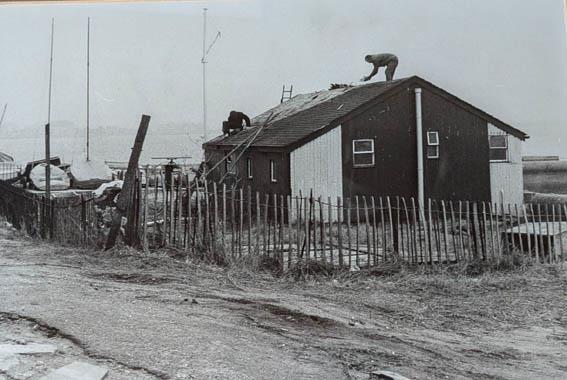
EDSC Members demolishing old Clubhouse in 1969
All of the loans were repaid on time and the Club emerged from a period of austerity and was able to contemplate such finishing touches as were deemed necessary.
The first of these was a special acoustic ceiling for the Clubroom. This was fitted in November 1973 and transformed the room dramatically, – ‘you can now hear yourself speak during parties and other gatherings,’ – was recorded in the Club minutes.
The concreting of the remaining area of the dinghy and car park was completed in the Spring of 1974.
A great improvement to the ‘Top Deck’ (roof) resulted from the generous gift to the Club of three memorial teak garden seats by certain members during the 1974 season.
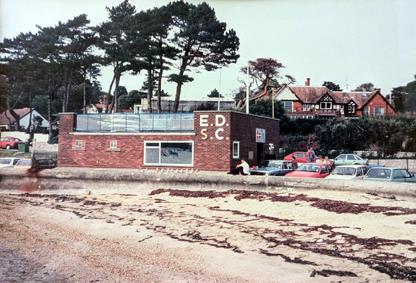
New Single Storey Clubhouse. 1970
Competitive Sailing
From the foundation of the Club, sailing activities have always been on a ‘do your own thing’ basis and still are to a very large extent, but the first spark of competitive activity can be traced to a letter received from Colonel Bersey, then Commodore of the Royal Motor Yacht Club (RMYC), who had written to the other three Clubs in the harbour, namely the East Dorset Sailing Club, Parkstone Yacht Club and the Hamworthy and Bournemouth Sailing Club (later to become Poole Yacht Club), inviting them to send representatives in the Autumn of 1947, to a meeting at the RMYC.
At this meeting it was decided that a six day Regatta should be held. The event would be sponsored by the four Clubs and supported by the Corporations of Poole and Bournemouth and by the Harbour Commissioners. The first Regatta was held from 28th June to 3rd July 1948, under the name of ‘The Poole and Bournemouth Yachting Week’ and was so successful that it became an Annual event, gradually changing its sponsorship and character and is now known simply as ‘Poole Week’ and is very ably staged and managed by Parkstone Yacht Club.
Our representatives at this first meeting were Mr. Percy Woodcock, (Commodore), Mr. Guy Emerson (Secretary) and Mr. J. G. Robinson. It was decided that each day’s racing should be run under the Burgee of the Club allocated for that day. EDSC’s ‘day’ that year was 29th June.
Mr. Hibbs of Hamworthy and Bournemouth Sailing Club suggested a levy of sixpence per head (2.5p) (from all Club members) towards preliminary expenses which was felt by the Clubs’ representatives to be a fair proposal.
Then someone proposed that there should be a minimum levy of £25 per Club and that if any Club was not prepared to donate such a sum they should not be represented at this meeting.
The EDSC Commodore, Mr. Percy Woodcock, on reporting to the full committee explained that ‘the Club’s representatives had no objection to a demand for a donation of £25 from each Club but they did resent the implication that if they would, or could not raise this sum they were not worthy of inclusion in the scheme’.
EDSC did subscribe 25 guineas to the funds for that year. This represented over £1 per head since EDSC had 22 members and was much more than the sixpence per head as originally suggested, it was a very creditable effort.
For good measure EDSC also provided a Silver Challenge Cup inscribed ‘Poole and Bournemouth Regatta’. This cup was returned to EDSC eventually and became one of the trophies competed for in Club Cruiser Races.
The Club’s ‘day’ for the first Regatta was celebrated in fine style with a garden party from 4p.m. to 6p.m. at Shore Lodge at the invitation of Colonel H. J. Finer and his wife. Invitations included the committee members of the other three Clubs and their ladies and the Mayors of Poole and Bournemouth (and presumably their ladies), the weather was kind and a good time was had by all.
The Regatta for 1949 was fixed for 4th-9th July, the Club’s ‘day’ was 5th July, and Colonel Finer, now Rear Commodore, laid on another garden party. It is interesting to note that, although it had been voted at the AGM in January that 25 guineas should be sent to the Regatta Fund, only £15 was in fact subscribed in May of that year.
For 1950 ten guineas was sent and the garden party at Shore Lodge was the largest so far – 200 guests were recorded as having attended.
This turned out to be the last of the garden parties because Colonel Finer and his family left Shore Lodge and went to live in South Africa.
In the minutes of a meeting on 16th March 1951, it was agreed that Mr. J. G. Robinson be elected Sailing Secretary of the Club and attend the Committee of the Poole and Bournemouth Yachting Week as such. This was the first time EDSC had appointed a Sailing Secretary.
Meanwhile, in the words of Commodore Percy Woodcock, ‘Time has brought some changes’. The Christchurch Sailing Club, though not situated in Poole Harbour, had given material support from the first and was invited to nominate representatives to the Committee of the Poole and Bournemouth Yachting Week. The Poole Harbour Yacht Club was founded in 1949.
Unfortunately, the interest of Bournemouth Corporation wilted and died in 1953 and the words ‘and Bournemouth’ were dropped from the title which became ‘Poole Yachting Week’.
The starting line for racing at first was off Bournemouth Pier, but was unpopular with the competitors, as they had a long way to sail before racing began, and in 1951, it was arranged that both starting and finishing lines should be in the Swash channel just outside the harbour entrance.
By 1957 interest in the newly styled ‘Poole Yachting Week’ had waned to the extent that our contribution to the funds was £1 and the Secretary, Mr. Alfred Burt, was instructed to write to Commander Oakley and point out to him that, as the Poole Yachting Week, in its original conception, had ceased to operate, the Club would like to have its Challenge Cup returned.
Poole Corporation withdrew their support in 1956 and Parkstone Yacht Club took over the sole responsibility for organising the event, now called ‘Poole Week’.
The election of Mr. J. G. Robinson as Sailing Secretary, lit the ‘spark’ for holding our own competitive sailing events which was further fanned by an offer from Major Douglas Milne to provide a Challenge Cup for ‘a centreboard dinghy race around Bulpit Beacon’.
The offer was well received and the Sailing Secretary, ‘Robbie’ as he had become affectionately known, was asked to ‘look into it’. This he did with great enthusiasm. He organised races for dinghies and power boats and for good measure produced and gave to the Club another Challenge Cup for the Power Boat race. The date was fixed for 26th August 1951 and the event proved to be a great success.
That was the beginning of the annual EDSC Regatette. ‘Robbie’ served the Club as Commodore from 1956 to 1959 and continued to organise and run the Regatette with undiminished enthusiasm during his term of office. After his term as Commodore, ‘Robbie’ was elected President of the Club and he also continued to act as Sailing Secretary.
It will be a long time before his record of service in joint offices is excelled, first as Rear Commodore/Sailing Secretary (there was no Vice Commodore in those days), then as Commodore/Sailing Secretary and subsequently as President/Sailing Secretary. He continued in office until the 1967 season, when he became ill and died shortly thereafter. Sixteen years in dual office, not to mention some years previously as a committee member is an impressive achievement.
Mr. Bernard Charles then took over as acting Sailing Secretary. He continued to organize the Regattette, adding new ideas of his own, and he laid on other sailing events. He will be remembered for the way in which he encouraged the youngsters to learn to sail. When Ken Latham produced the ‘Poole Sprat’, he organised a ‘Sprat Week’, that preceded the Regattette, when he and other enthusiasts trained youngsters in sailing techniques and how to sail around a course. For two seasons he organised a Junior Dinghy race in which the entrants were mostly in ‘Sprats’.
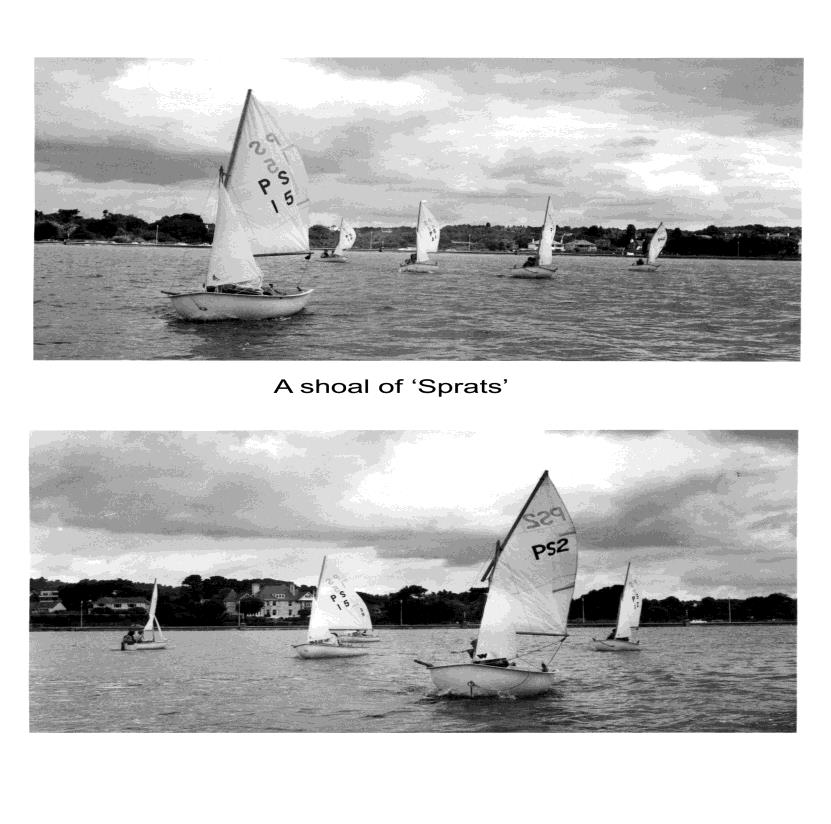
By this time the numbers of moored craft in EDSC waters had increased considerably. No one had bothered to regulate the positioning of these moorings, until Bernard took on the massive task of reorganising and positioning them in some sort of pattern. He also managed to move out some of the ‘non-members’ from EDSC waters.
He was also responsible for laying on the Club’s first ever Cruiser Race. This was the famous occasion when the Race Officer and his wife, having started the race from EDSC Clubhouse ‘Top Deck’, were in the Haven Hotel enjoying their lunch (at EDSC expense), when, to their horror, they saw the leading boat charging back into the harbour a good hour or more before expected. Luckily he beat them to the line!
Lesley Lees took over from Bernard Charles in May 1970. The EDSC sailing cruiser fleet had grown considerably by then and the Club decided to make the Club Cruiser Race an annual event. Mr. Tipple, then Commodore of Parkstone Yacht Club, and a very experienced race officer, very kindly agreed to assist and train some of EDSC members in race procedures, thereby enabling the Club to organise and stage its own races. Over a course in Poole Bay the cruiser race proved to be an increasingly popular event.
In 1970, a member very generously gave EDSC an antique candelabra for a sailing trophy, which heralded the start of another annual cruiser race over a tougher course in Poole Bay but, this time open to all the Clubs in Poole Harbour, for sailing cruisers up to 24 feet L.O.A. (Poole Yacht Racing Association Class 3).
Known as ‘The Candelabra Trophy Race’ it was staged for the Club by Lilliput Sailing Club for the first time in July 1970. Since then EDSC staged it and it became a very popular fixture. In July 1973 twenty five Class 3 Cruisers competed from five Clubs.
In 1973 Ken Okey started organising week-end cruises for a small group of Club boats. Initially visits to Lulworth and the Isle of Wight were made, and as the number and size of cruisers increased so did the number of cruises and the distances travelled.
In the Club’s centenary year in 1975, Lesley Lees wrote, ‘we may at last be growing out of our nickname of the ‘Potterers’, but – we must never lose sight of the intentions of our founders which was to enable members just to enjoy messing about in boats’.
There are two members from this period who deserve special recognition, firstly Mr. Guy Emerson, who joined the Club in 1936 and was Secretary and Treasurer from 1945 until 1956. He was meticulous in his work, writing very full (and legible) minutes which have been invaluable in the writing of this history. Secondly, Miss Annette Bailey, who joined the Club in 1948, became Secretary (and Treasurer) in 1959 and continued in post as Club Secretary until 1974. In all the hand-written minute books she would sign herself ‘Hon. Mug’, a reflection many subsequent secretaries would take to heart. Annette was invaluable to the Club as year after year she supported the Commodores and helped to encourage both young and old to keep on sailing. Everyone in the local yachting circle, in fact in the whole local community, knew ‘Annette’ and of her association with the East Dorset Sailing Club. Sadly Annette past away in 2009.
Social Events
It is interesting to follow the gradual change in the venue for committee meetings and social gatherings during the first hundred years.
The number of members remained small from foundation until 1946 and the Clubhouse accommodation was either non-existent or inadequate, so all meetings were held in the homes of either the Commodores or Committee members. Ordinary committee meetings from 1946 until 1969 were held in the ‘corrugated iron’ Clubhouse. AGMs and all social functions were held in hotels.